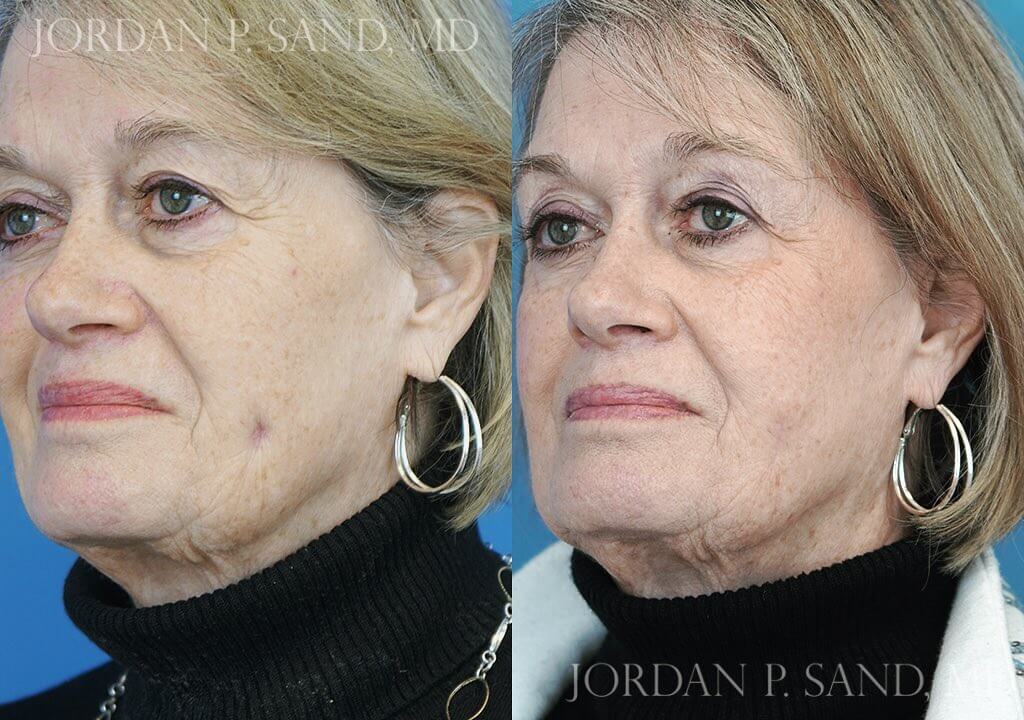

Facelift
Procedures offered at our clinic in Spokane: facelift, deep plane facelift,….


Surgical and non-surgical hair restoration with Dr. Jordan Sand, a double board-certified facial plastic surgeon with fellowship training in hair restoration.
Procedures offered include: medical hair restoration therapy, nonsurgical hair restoration, and surgical hair restoration. Serving Spokane, Coeur d’Alene, and the Inland Northwest.
A hair transplant moves living hair follicles from areas of the scalp that are genetically resistant to hair loss (the back and sides of the head) to areas where the hair has thinned or receded. Because these donor follicles retain their resistance to the hormonal signals that cause male and female pattern hair loss, the transplanted hair continues to grow in its new location as it did in its original one.
At Sand Plastic Surgery, the procedure takes place in our office under local anesthesia. Patients are awake and comfortable, can eat normally beforehand, and typically spend the day reading or watching movies while Dr. Sand and his team work. A full procedure takes most of a single day.
The steps:
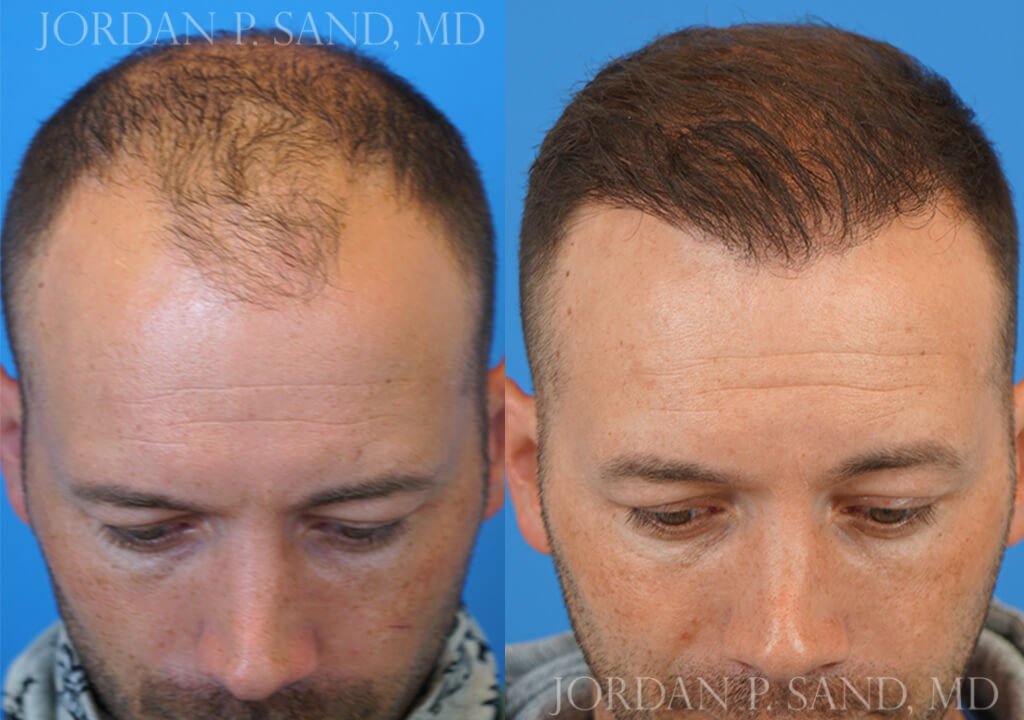
The result is a hairline and density pattern designed to look the way your hair would have looked if it had never receded.
Dr. Sand approaches hair restoration the same way he approaches facial plastic surgery: as a question of aesthetic design first and surgical execution second. The hairline is the most visible result of a transplant, and it is the part of the procedure that most often gives away surgical work when it is done poorly. Dr. Sand designs each hairline to match the patient’s facial proportions, age, and ethnicity, and to remain natural-looking as the patient continues to age. Within the hairline, single-hair grafts in the front are feathered into progressively larger grafts toward the back, producing the microvariations and density gradient of natural hair.
The hairs are harvested from the back and sides of the head as a strip (FUT, follicular unit transfer) or can be extracted individually (FUE, follicular unit extraction). All of these procedures are office-based and performed with local anesthesia. Fasting is not necessary and you will spend much time during the procedure reading, listening to music or watching movies. Surgical hair restoration is very well tolerated with a highly reproducible and natural result.
The best option for you will be discussed during your consultation with Dr. Sand.
Both techniques harvest follicles from the same area of the scalp and produce the same type of transplanted graft. The difference is how the follicles are harvested.
Follicular Unit Extraction (FUE) extracts individual follicular units one at a time using a small circular punch. There is no linear incision and no stitches. Recovery is quicker and the donor area heals as a pattern of tiny dot-shaped marks that are typically invisible once the surrounding hair grows back in. FUE is well suited to patients who wear their hair short, patients who want the fastest recovery, and patients harvesting smaller numbers of grafts.
Follicular Unit Transplantation (FUT) removes a thin strip of scalp from the donor area and dissects it under microscope into individual grafts. This leaves a fine linear scar at the donor site that is concealed by surrounding hair when the hair is worn at any length longer than a buzz cut. FUT is well suited to patients who need a high graft count in a single session, patients whose donor density is limited, and patients who want to preserve maximum capacity for future sessions.
The right technique depends on your graft count, donor density, lifestyle, and how you typically wear your hair. Dr. Sand discusses both options at consultation and recommends the one that fits your situation.
A good hair transplant candidate has three things: sufficient donor hair density, a stable pattern of hair loss, and realistic expectations about what surgery can accomplish.
Most candidates are adults in their late 20s through their 60s with male or female pattern hair loss, a receding or thinning hairline, or a stable pattern of loss in the crown or temples. Patients in their early 20s are evaluated carefully because their hair loss pattern may not yet be stable, and operating before the pattern stabilizes can produce results that look unnatural as the surrounding hair continues to recede.
Candidates with diffuse thinning rather than pattern loss, very limited donor density, certain scalp conditions, or expectations that a transplant will restore the hair density of their teens are typically not good candidates and Dr. Sand will say so at consultation. Medical and non-surgical options (finasteride, minoxidil, PRP, low-level laser therapy) may be more appropriate, and are often recommended alongside or instead of surgery.
The goal of an honest candidacy conversation is to make sure the patients who proceed are the ones who will be happy with the result.
Most patients return to work and normal activity within 3 to 5 days after surgery. Strenuous exercise resumes around 2 weeks.
The first week. The donor area and recipient sites are tender. Small scabs form at each graft site and shed naturally over 7 to 14 days. Patients sleep with their head slightly elevated for the first few nights and avoid touching the recipient area. Detailed post-op instructions are provided.
Weeks 2 through 4. The transplanted hairs themselves shed. This is the shedding phase and it is the part of the recovery that surprises patients most often. The follicles are healthy and in place; only the hair shafts are shedding. This is a normal part of the process and is followed by new growth from the same follicles.
Months 2 through 4. The transplanted follicles enter a resting phase. There is little visible change during this period.
Months 4 through 8. New hair growth becomes visible. The hair comes in fine at first and progressively thickens.
Months 8 through 12. Density builds and the final result takes shape. The hair behaves like the patient’s natural hair: it can be cut, styled, washed, and treated normally.
Month 12 and beyond. The final result is typically apparent at 12 months. The transplanted hair continues to grow for the rest of the patient’s life. For patients interested in additional detail, see our guide on what to expect during the hair transplant recovery process.
Hair restoration for both men and women can be provided through medical therapy, minimally invasive treatments or surgical restoration. Finasteride (Propecia®) and minoxidil (Rogaine®) are the two most popular medical treatments for hair loss. Various vitamin and natural topical treatments can also be recommended. Medical therapy is often the right first step for patients with early thinning, and is frequently combined with surgical restoration to protect the patient’s existing hair while the transplanted hair establishes itself.
Platelet-rich plasma (PRP) injections are a highly effective treatment for stimulating hair growth and may be an excellent option for the male or female patient with thinning hair. In a recent review written by Dr. Sand entitled: “PRP for the Aesthetic Surgeon“, many uses for PRP are discussed. They include topical application to improve healing after skin resurfacing, injection into face to remove wrinkles, and injection into the scalp for hair restoration. In particular, the use of PRP for hair restoration has been studied by multiple global investigators and has shown excellent promise as a treatment for thinning or micronized hairs. High qualities studies have shown this product to thicken hair shaft size, improve hair quality, and increase hair density. This combined effect can lead to fuller, healthier appearing head of hair. Dr. Sand can discuss the benefits of this treatment with you during your consultation.
At Sand Plastic Surgery, we provide state-of-the-art solutions for hair restoration. Our partnership with GetHairMD offers advanced options tailored to meet individual needs. Here’s how we can help you achieve healthier, fuller hair:
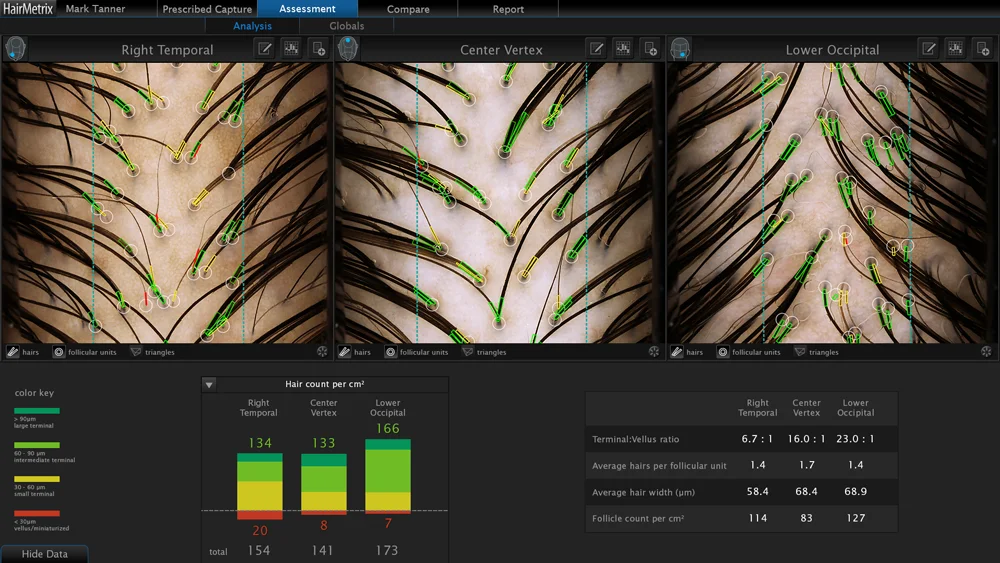
Gain a deeper understanding of your hair health with HairMetrix, an AI-powered imaging system. This non-invasive technology provides a detailed analysis of your scalp and hair, helping us create a personalized treatment plan.
Unlock the secrets of your DNA with advanced genetic testing. By identifying compounds that work best for your unique biology, we can target your hair restoration journey with precision and efficiency.
Boost hair regrowth with our Clinical Hair Growth Laser therapy. This safe, painless treatment stimulates the scalp to improve hair thickness and density by increasing blood flow and activating hair follicles.
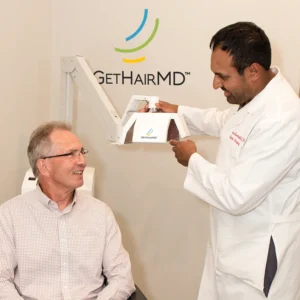
Experience the regenerative power of platelet-rich plasma without the need for injections. Our transdermal infusion technology delivers PRP directly to the scalp, promoting hair growth and scalp health comfortably and effectively.
Revolutionize your hair restoration with the Dual Wave Energy Cap. Using innovative light therapy, this at-home device enhances hair density and strengthens follicles in a convenient, easy-to-use format.
Support your treatment plan with specially formulated hair regrowth shampoos. These products are designed to nourish your scalp and strengthen hair, serving as an essential component of your daily routine.
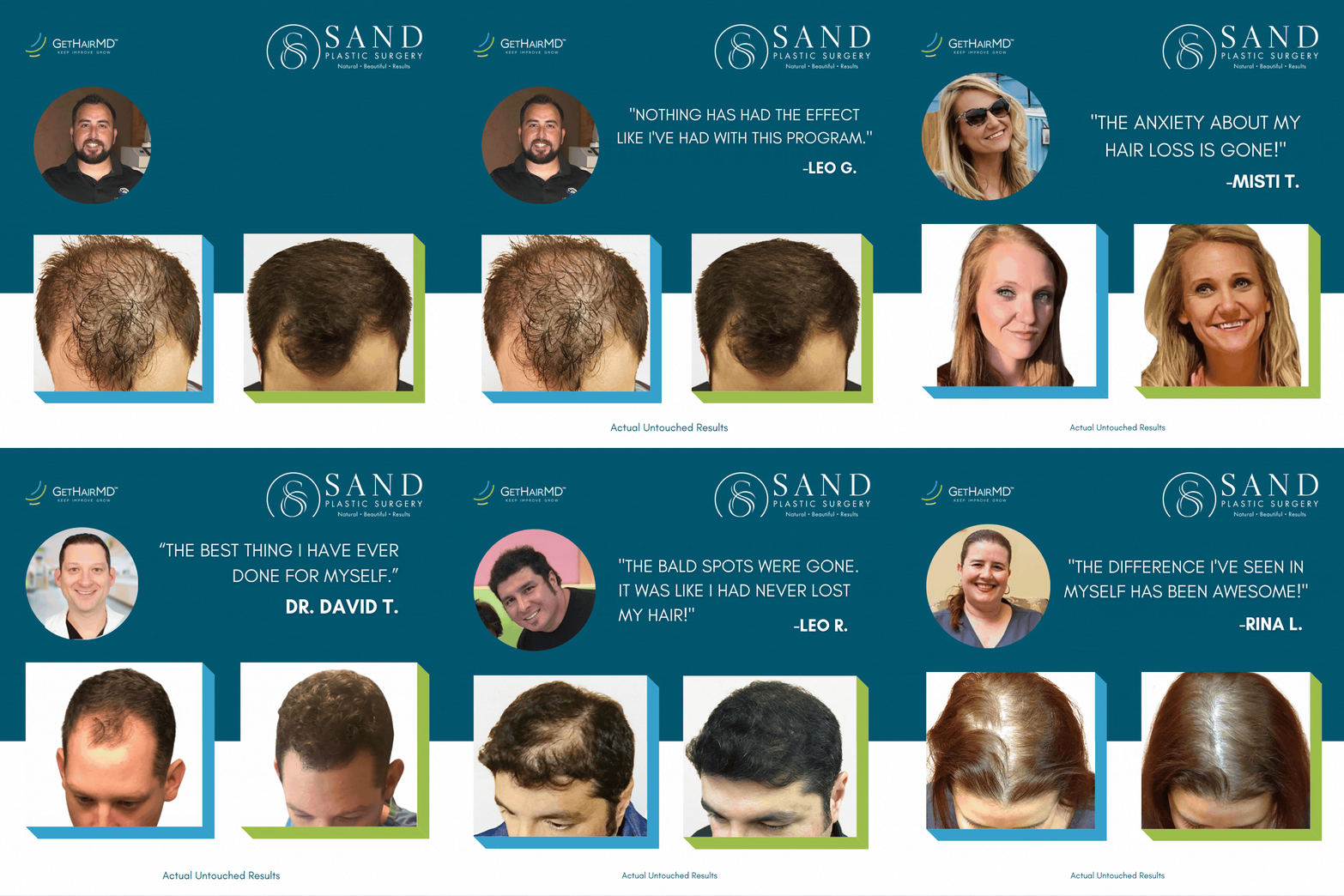
Most hair transplants in the United States are performed by dedicated hair restoration clinics that operate on a higher-volume model. Dr. Sand’s practice is the opposite: a single double board-certified facial plastic surgeon who performs a smaller number of cases per year, designs every hairline personally, and creates every recipient site by hand.
The distinction matters because the hairline is the visible part of the result. A transplant performed by a technician under the supervision of a physician, on a clinic floor running multiple cases in parallel, can produce a clinically successful outcome. A transplant performed by a fellowship-trained facial plastic surgeon who treats hair restoration as a facial aesthetic procedure produces a different kind of outcome.
Dr. Sand’s credentials specific to hair restoration:
Hair restoration is one of three areas of focus in Dr. Sand’s practice, alongside facelift surgery and rhinoplasty. The face-and-scalp-only specialization is the structural reason the result is different.
When looking for the best hair transplant surgeon near you, consider a highly-experienced surgeon like Dr. Sand, whose double-board certification and expertise in facial plastic surgery extend to meticulous procedures such as hair transplantation. Look for a surgeon with a proven track record in hair restoration, demonstrated through before and after galleries that showcase their ability to achieve natural and dense hair growth. The surgeon’s experience with both FUE (Follicular Unit Extraction) and FUT (Follicular Unit Transplantation) techniques, along with patient testimonials, can guide you to make an informed decision. A detailed consultation will allow you to understand the surgeon’s approach to hair restoration, ensuring that it aligns with your expectations and needs.
This is an office-based procedure done under local anesthesia. There is no need to fast for the procedure and you will eat lunch with the time and spend much of the day reading or watching movies while the procedure takes place. It is well tolerated and the results are very robust.
Platelet-rich plasma is a condensation of platelets and growth factors from your blood that are extracted and then re-injected into the scalp where the hair is thinning. The growth factors then stimulate micronized hair follicles and surrounding hairs to becoming thicker, more robust and higher quality. The effect of this injection does wear off after several months and requires maintenance therapy.
A natural-looking result is the goal of every transplant and is the part of the procedure most affected by surgical technique. Dr. Sand designs each hairline by hand, angles every recipient site to match the surrounding hair’s growth pattern, and feathers single-hair grafts into the front of the hairline to soften its edge. Patients are encouraged to review before and after photos at consultation to see specific examples.
Most patients return to desk work and light activity within 3 to 5 days. Strenuous exercise, including running and weightlifting, resumes around 2 weeks. Swimming and direct sun exposure to the scalp are avoided for the first 3 to 4 weeks.
The transplanted hair is taken from areas of the scalp that are genetically resistant to hair loss, and it retains that resistance in its new location. The transplanted hair is permanent. However, the patient’s surrounding non-transplanted hair can continue to thin over time, which is why medical therapy (finasteride or minoxidil) is often recommended alongside surgery to protect the patient’s remaining native hair.
Cost depends on graft count, technique (FUE or FUT), and the complexity of the case. Sand Plastic Surgery does not publish a single price because it would not be accurate for most patients. Specific pricing is discussed at consultation once a graft count and plan have been established.